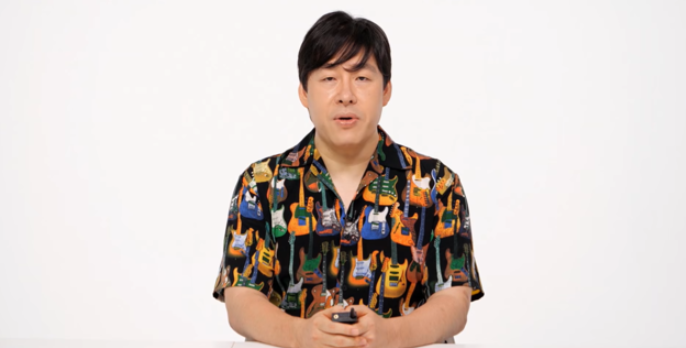
Min-seok Sung, COO of ONEPREDICT
"What does Physical AI mean on the factory floor? Are we witnessing a true technological revolution, or is it naming inflation?"
Min-seok Sung, Vice President and COO of ONEPREDICT, posed this question during a webinar on the 31st titled 'AI Native Factory - Physical AI: From Judgment to Execution.' He answered, "While there is clear inflation surrounding the term 'Physical AI,' the convergence of technologies occurring under that label is certainly not inflation."
Sung first explained that the technologies currently categorized as Physical AI are not entirely new. The constituent building blocks of Physical AI already existed across traditional manufacturing sites. Sensors detected equipment conditions, predictive maintenance AI forecasted failures, and robots performed pre programmed actions. However, these technologies operated in isolation within their respective machinery and systems, failing to share a common understanding of situations or collaborate toward unified goals.
Recently, a shift began as foundation models and multimodal AI gained the ability to integrally understand language, images, video, and sensor data, applying this learned knowledge to novel environments. Vision-Language-Action (VLA) models connect these cognitive capabilities directly to action planning and control. Furthermore, AI agents aggregate production schedules, work orders, quality benchmarks, equipment states, and maintenance histories to invoke multiple systems and plan and execute real world tasks.
Sung noted, "The core takeaway is not that entirely unprecedented technologies have emerged, but rather that technologies that evolved separately for years are now converging around foundation models."
The Paradigm Shift in Manufacturing Processes Brought by AI
AI has become the central catalyst unifying fragmented automation systems across manufacturing sites. The industry is transitioning from Rigid Automation where systems perform fixed actions under fixed conditions to Adaptive Automation, where AI interprets situations and selects optimal actions dynamically.
The core elements defining the workflow of Physical AI—'Perception, Understanding, Judgment, Action, and Learning'—previously existed as standalone technologies across various industries, operating on separate machines without mutual integration. Physical AI serves as the overarching architecture unifying these previously non collaborative systems.
Legacy automation operated by pre defining a specific problem and solving it rigidly. Vision systems identified pre set defect types, robots executed pre programmed movements, and predictive maintenance AI forecasted anomaly patterns for specific machinery.
While this approach yielded high performance for fixed problems, it created bottlenecks whenever products or processes changed, requiring engineers to rewrite rules or retrain models from scratch.
Today, foundation models and multimodal AI comprehend language, imagery, video, and sensor inputs, transferring learned insights to novel environments. Consequently, adaptive systems driven by goal oriented dynamics have begun to evolve.
Expanding the Scope of Physical AI Across the Entire Factory
Physical AI can expand beyond the intelligence of a single robot to encompass the intelligence of an entire factory floor. When diverse equipment, AI models, and operational systems are connected through a feedback loop that shares a common situational awareness, the entire facility transforms into a unified Physical AI space.
"When people hear 'Physical AI,' they typically picture humanoids, but that narrows its true potential too much," Sung explained. "The critical factor is not the physical shape of the body, but the physical system through which AI impacts reality."
ONEPREDICT envisions the scope of Physical AI to include numerous factory components. Hardware devices like Autonomous Mobile Robots (AMRs) and drones, as well as industrial machinery like CNC machines, compressors, and turbines, are interpreted as part of Physical AI. Furthermore, actions that exert physical influence on the real world such as adjusting valve openings, modulating pump speeds, or altering temperature and pressure setpoints also constitute integral parts of Physical AI.
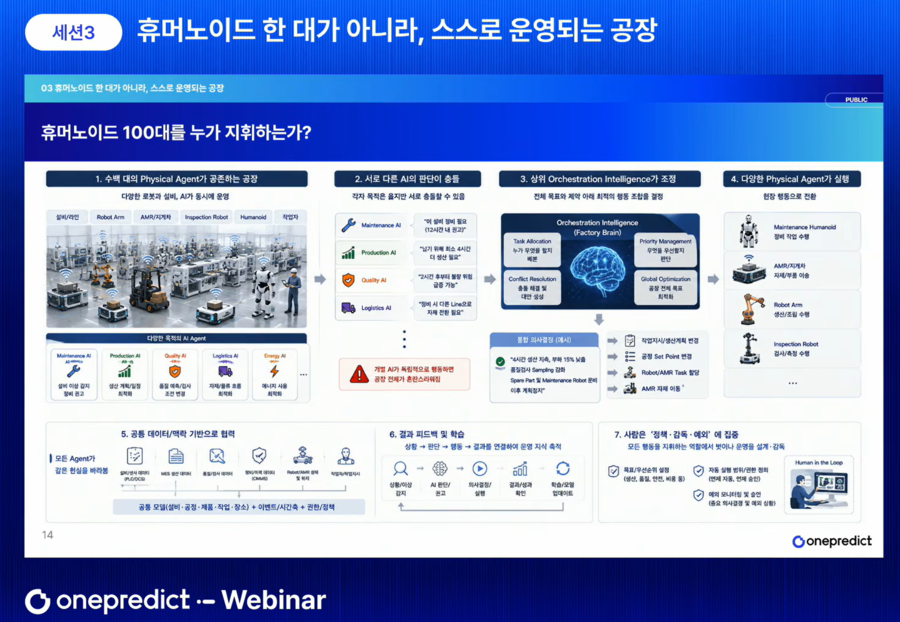
ONEPREDICT Operational Workflow
AI Native Operating System (OS): Essential Requirement for Autonomous Factory Operations
Sung projected that future factories will likely not be controlled by a single monolithic AI, but will instead operate through a collaborative framework where multiple AI models and control systems with distinct timeframes and specialized roles cooperate. Deterministic controllers handle high speed motor control, specialized AI optimizes processes, and higher level decision making across production, maintenance, and quality is coordinated by multiple domain agents.
For example, if an anomaly is detected in critical equipment, maintenance AI might determine that servicing is required within 12 hours. Meanwhile, production AI might report that operations must run for 6 more hours to meet delivery deadlines, while quality AI flags defect risks. Each judgment is valid within its respective domain objective, yet they directly conflict with one another.
Consequently, 'Factory Intelligence' enabling plants to self optimize and make balanced judgments will become a vital prerequisite for intelligent autonomous manufacturing. The core enabler of Factory Intelligence is an 'AI Native OS.' The AI Native OS reconciles priorities among multiple AI agents, aligning them toward a unified overarching goal.
The roles of an AI Native Factory OS center on three main functions: ▲ Contextualizing factory states, ▲ Managing goals and constraints, and ▲ Orchestrating plant wide objectives.
Contextualizing factory states involves unifying data across machinery and infrastructure—including Programmable Logic Controllers (PLCs), Distributed Control Systems (DCS), Manufacturing Execution Systems (MES), quality results, maintenance logs, and operational statuses of robots and AMRs. This ensures AI can assess real time production status alongside historical anomaly patterns.
Managing goals and constraints entails holistically balancing cost effective throughput, delivery deadlines, quality standards, equipment health, safety protocols, and energy efficiency. To instill this operational context, process priorities, automated execution workflows, approval policies, and authorization governance must be programmed into the AI Native Factory OS.
The Future Factory: 'Autonomy' Over 'Automation' as the Core Focus
As a blueprint for future factories, Sung presented 'factories designed with autonomous goals and principles for action' rather than fully lights out, unmanned facilities. While automation delegates action execution to pre defined conditions and hardcoded rules, autonomy empowers systems to interpret situations, evaluate constraints, and independently select optimal actions.
Autonomy does not replace legacy automation. Even in autonomous plants, low level motor controls, emergency stops, and safety interlocks remain governed by deterministic control mechanisms. However, long horizon, complex decision making is realistically assigned to AI. Low level control operates safely and rapidly, while higher level AI coordinates multi objective trade offs.
Furthermore, Sung clarified that factory autonomy does not mean granting unchecked authority to AI. "Becoming an autonomous factory is less about achieving complete lights out operations and more about elevating humans to supervisory management roles," he explained.
Human intervention based on autonomy maturity is broadly categorized into three tiers: Human-in-the-Loop, Human-on-the-Loop, and Human-above-the-Loop. Each stage serves as a design principle determining the level of decision making and execution authority delegated to AI.
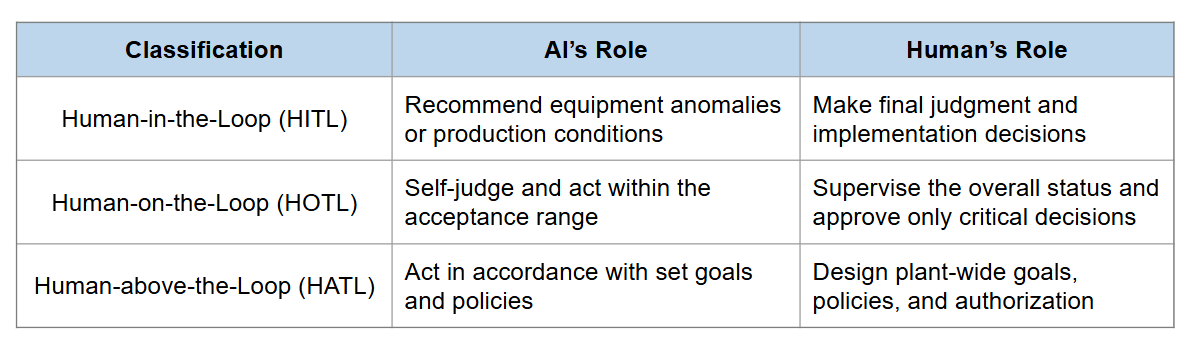
Source: Byline Network
ONEPREDICT Presents Physical AI Based Platforms
Finally, ONEPREDICT introduced software solutions designed to integrate plant data, laying the foundation for full factory autonomy. Its industrial AI ready data platform 'cyclone' and AI application platform 'PDX' consolidate fragmented factory data to create a reusable common foundation for AI models.
'cyclone' is a manufacturing data and MLOps platform that ingests and integrates heterogeneous Operational Technology (OT) and Information Technology (IT) data. Building upon 'cyclone', 'PDX' resolves maintenance and quality challenges through AI, supporting the deployment and management of AI applications in live operational environments.
ONEPREDICT emphasized that manufacturers must begin interconnecting factory data and accumulating experience in solving maintenance and quality issues with AI today to successfully expand into AI agents, Physical AI, and autonomous factories tomorrow. Sung concluded, "Future AI models and robotics can be purchased down the road, but the factories that teach them what to observe, how to make decisions, and where to act must be built starting right now."
Source: Byline Network (https://byline.network )


 ...
 ...

 ...
 ...


Min-seok Sung, COO of ONEPREDICT
"What does Physical AI mean on the factory floor? Are we witnessing a true technological revolution, or is it naming inflation?"
Min-seok Sung, Vice President and COO of ONEPREDICT, posed this question during a webinar on the 31st titled 'AI Native Factory - Physical AI: From Judgment to Execution.' He answered, "While there is clear inflation surrounding the term 'Physical AI,' the convergence of technologies occurring under that label is certainly not inflation."
Sung first explained that the technologies currently categorized as Physical AI are not entirely new. The constituent building blocks of Physical AI already existed across traditional manufacturing sites. Sensors detected equipment conditions, predictive maintenance AI forecasted failures, and robots performed pre programmed actions. However, these technologies operated in isolation within their respective machinery and systems, failing to share a common understanding of situations or collaborate toward unified goals.
Recently, a shift began as foundation models and multimodal AI gained the ability to integrally understand language, images, video, and sensor data, applying this learned knowledge to novel environments. Vision-Language-Action (VLA) models connect these cognitive capabilities directly to action planning and control. Furthermore, AI agents aggregate production schedules, work orders, quality benchmarks, equipment states, and maintenance histories to invoke multiple systems and plan and execute real world tasks.
Sung noted, "The core takeaway is not that entirely unprecedented technologies have emerged, but rather that technologies that evolved separately for years are now converging around foundation models."
The Paradigm Shift in Manufacturing Processes Brought by AI
AI has become the central catalyst unifying fragmented automation systems across manufacturing sites. The industry is transitioning from Rigid Automation where systems perform fixed actions under fixed conditions to Adaptive Automation, where AI interprets situations and selects optimal actions dynamically.
The core elements defining the workflow of Physical AI—'Perception, Understanding, Judgment, Action, and Learning'—previously existed as standalone technologies across various industries, operating on separate machines without mutual integration. Physical AI serves as the overarching architecture unifying these previously non collaborative systems.
Legacy automation operated by pre defining a specific problem and solving it rigidly. Vision systems identified pre set defect types, robots executed pre programmed movements, and predictive maintenance AI forecasted anomaly patterns for specific machinery.
While this approach yielded high performance for fixed problems, it created bottlenecks whenever products or processes changed, requiring engineers to rewrite rules or retrain models from scratch.
Today, foundation models and multimodal AI comprehend language, imagery, video, and sensor inputs, transferring learned insights to novel environments. Consequently, adaptive systems driven by goal oriented dynamics have begun to evolve.
Expanding the Scope of Physical AI Across the Entire Factory
Physical AI can expand beyond the intelligence of a single robot to encompass the intelligence of an entire factory floor. When diverse equipment, AI models, and operational systems are connected through a feedback loop that shares a common situational awareness, the entire facility transforms into a unified Physical AI space.
"When people hear 'Physical AI,' they typically picture humanoids, but that narrows its true potential too much," Sung explained. "The critical factor is not the physical shape of the body, but the physical system through which AI impacts reality."
ONEPREDICT envisions the scope of Physical AI to include numerous factory components. Hardware devices like Autonomous Mobile Robots (AMRs) and drones, as well as industrial machinery like CNC machines, compressors, and turbines, are interpreted as part of Physical AI. Furthermore, actions that exert physical influence on the real world such as adjusting valve openings, modulating pump speeds, or altering temperature and pressure setpoints also constitute integral parts of Physical AI.
ONEPREDICT Operational Workflow
AI Native Operating System (OS): Essential Requirement for Autonomous Factory Operations
Sung projected that future factories will likely not be controlled by a single monolithic AI, but will instead operate through a collaborative framework where multiple AI models and control systems with distinct timeframes and specialized roles cooperate. Deterministic controllers handle high speed motor control, specialized AI optimizes processes, and higher level decision making across production, maintenance, and quality is coordinated by multiple domain agents.
For example, if an anomaly is detected in critical equipment, maintenance AI might determine that servicing is required within 12 hours. Meanwhile, production AI might report that operations must run for 6 more hours to meet delivery deadlines, while quality AI flags defect risks. Each judgment is valid within its respective domain objective, yet they directly conflict with one another.
Consequently, 'Factory Intelligence' enabling plants to self optimize and make balanced judgments will become a vital prerequisite for intelligent autonomous manufacturing. The core enabler of Factory Intelligence is an 'AI Native OS.' The AI Native OS reconciles priorities among multiple AI agents, aligning them toward a unified overarching goal.
The roles of an AI Native Factory OS center on three main functions: ▲ Contextualizing factory states, ▲ Managing goals and constraints, and ▲ Orchestrating plant wide objectives.
Contextualizing factory states involves unifying data across machinery and infrastructure—including Programmable Logic Controllers (PLCs), Distributed Control Systems (DCS), Manufacturing Execution Systems (MES), quality results, maintenance logs, and operational statuses of robots and AMRs. This ensures AI can assess real time production status alongside historical anomaly patterns.
Managing goals and constraints entails holistically balancing cost effective throughput, delivery deadlines, quality standards, equipment health, safety protocols, and energy efficiency. To instill this operational context, process priorities, automated execution workflows, approval policies, and authorization governance must be programmed into the AI Native Factory OS.
The Future Factory: 'Autonomy' Over 'Automation' as the Core Focus
As a blueprint for future factories, Sung presented 'factories designed with autonomous goals and principles for action' rather than fully lights out, unmanned facilities. While automation delegates action execution to pre defined conditions and hardcoded rules, autonomy empowers systems to interpret situations, evaluate constraints, and independently select optimal actions.
Autonomy does not replace legacy automation. Even in autonomous plants, low level motor controls, emergency stops, and safety interlocks remain governed by deterministic control mechanisms. However, long horizon, complex decision making is realistically assigned to AI. Low level control operates safely and rapidly, while higher level AI coordinates multi objective trade offs.
Furthermore, Sung clarified that factory autonomy does not mean granting unchecked authority to AI. "Becoming an autonomous factory is less about achieving complete lights out operations and more about elevating humans to supervisory management roles," he explained.
Human intervention based on autonomy maturity is broadly categorized into three tiers: Human-in-the-Loop, Human-on-the-Loop, and Human-above-the-Loop. Each stage serves as a design principle determining the level of decision making and execution authority delegated to AI.

Source: Byline Network
ONEPREDICT Presents Physical AI Based Platforms
Finally, ONEPREDICT introduced software solutions designed to integrate plant data, laying the foundation for full factory autonomy. Its industrial AI ready data platform 'cyclone' and AI application platform 'PDX' consolidate fragmented factory data to create a reusable common foundation for AI models.
'cyclone' is a manufacturing data and MLOps platform that ingests and integrates heterogeneous Operational Technology (OT) and Information Technology (IT) data. Building upon 'cyclone', 'PDX' resolves maintenance and quality challenges through AI, supporting the deployment and management of AI applications in live operational environments.
ONEPREDICT emphasized that manufacturers must begin interconnecting factory data and accumulating experience in solving maintenance and quality issues with AI today to successfully expand into AI agents, Physical AI, and autonomous factories tomorrow. Sung concluded, "Future AI models and robotics can be purchased down the road, but the factories that teach them what to observe, how to make decisions, and where to act must be built starting right now."
Source: Byline Network (https://byline.network )