Byeng-dong Youn, CEO of ONEPREDICT, appeared on the YouTube channel 'Knowledge Inside' and presented the 'AI Native Factory' as a new paradigm for the manufacturing industry in the AI era.
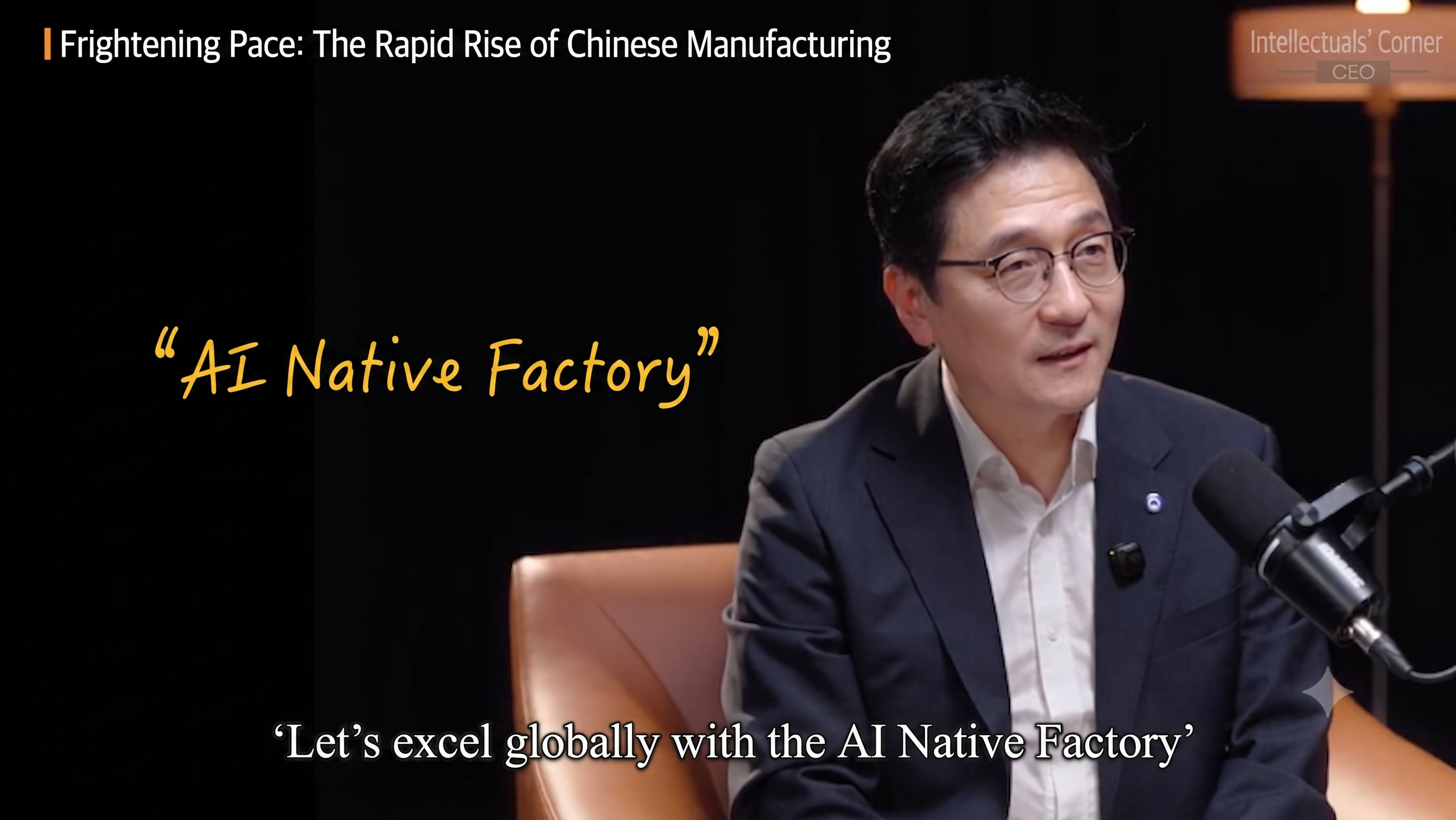
Byeng-dong Youn, CEO of ONEPREDICT, appeared on the YouTube channel 'Knowledge Inside' and presented the 'AI Native Factory' as a new paradigm for the manufacturing industry in the AI era.
Appearing on 'Knowledge Inside', CEO Byeng-dong Youn diagnosed that manufacturing is no longer merely a production industry, but has transformed into a strategic industry that determines national security, supply chains, and technological supremacy.
Youn explained: "The US is fostering advanced manufacturing as the core of national competitiveness, while China is rapidly boosting its manufacturing edge by pairing its vast manufacturing base with AI. The competitive benchmark of manufacturing is shifting quickly from 'how much is produced' to 'how well AI operates the factory.'"
Youn proposed the 'AI Native Factory' as a solution to this changing era. He defined an AI Native Factory as a next generation manufacturing operating system where AI centrally manages end to end manufacturing operations, including production, quality, maintenance, energy, and supply chain.
While traditional smart factories focused on plant digitalization and automation, the core of an AI Native Factory lies in AI understanding manufacturing data, making autonomous judgments, and running plant operations. In short, it represents a new manufacturing paradigm where AI moves beyond assisting the factory to becoming the core of plant operations.
He highlighted 'assetization of manufacturing data' as the core competitiveness for realizing AI Native Factories. Although vast amounts of data currently exist on shop floors, most remain 'consumable data' that disappear after a single use. He stressed that to enable continuous AI learning, this must be converted into 'assetized data' containing rich context—such as production history, quality outcomes, and operator judgments.
Furthermore, he projected that specialized AI Agents across manufacturing tasks—such as production, quality, maintenance, and energy—alongside an overarching AI Super Agent, will play the central role in running factory operations.
When the experience and know how of veteran manufacturing experts are accumulated as data and learned by AI Agents, a new level of manufacturing competitiveness can be secured, solving labor shortages and technology transfer challenges.
Youn cited South Korea's concentrated industrial base—spanning semiconductors, automotive, batteries, shipbuilding, and steel—as the nation's core strength. He explained that this environment provides a distinct advantage for applying and verifying AI across diverse production floors, and subsequently spreading proven models industry wide.
Youn stated: "The AI Native Factory is a new manufacturing paradigm where AI evolves beyond assisting factories to becoming the center of operations. Going forward, the benchmark for manufacturing competitiveness will change from how much is produced to how effective a manufacturing ecosystem can be built for AI to work in."
He continued: "South Korea is a nation equipped with world class manufacturing data, domain experts, and real world testing environments to verify technologies on actual production floors. Combining these strengths with AI will allow us to be the first to realize the AI Native Factory era and lead global manufacturing innovation."
Meanwhile, ONEPREDICT is developing core technologies to realize AI Native Factories based on manufacturing data assetization and manufacturing AI agent technologies. The company is currently refining AI based autonomous manufacturing technology through government initiatives—such as the Ministry of Trade, Industry and Energy's AI Factory Flagship Project and Industrial AI Agent Development and Demonstration Projects. Moving forward, ONEPREDICT plans to scale the AI Native Factory models verified on domestic production floors out to the global market.
Source : IndustryNews (https://www.industrynews.co.kr)


 ...
 ...

 ...
 ...


Byeng-dong Youn, CEO of ONEPREDICT, appeared on the YouTube channel 'Knowledge Inside' and presented the 'AI Native Factory' as a new paradigm for the manufacturing industry in the AI era.

Byeng-dong Youn, CEO of ONEPREDICT, appeared on the YouTube channel 'Knowledge Inside' and presented the 'AI Native Factory' as a new paradigm for the manufacturing industry in the AI era.
Appearing on 'Knowledge Inside', CEO Byeng-dong Youn diagnosed that manufacturing is no longer merely a production industry, but has transformed into a strategic industry that determines national security, supply chains, and technological supremacy.
Youn explained: "The US is fostering advanced manufacturing as the core of national competitiveness, while China is rapidly boosting its manufacturing edge by pairing its vast manufacturing base with AI. The competitive benchmark of manufacturing is shifting quickly from 'how much is produced' to 'how well AI operates the factory.'"
Youn proposed the 'AI Native Factory' as a solution to this changing era. He defined an AI Native Factory as a next generation manufacturing operating system where AI centrally manages end to end manufacturing operations, including production, quality, maintenance, energy, and supply chain.
While traditional smart factories focused on plant digitalization and automation, the core of an AI Native Factory lies in AI understanding manufacturing data, making autonomous judgments, and running plant operations. In short, it represents a new manufacturing paradigm where AI moves beyond assisting the factory to becoming the core of plant operations.
He highlighted 'assetization of manufacturing data' as the core competitiveness for realizing AI Native Factories. Although vast amounts of data currently exist on shop floors, most remain 'consumable data' that disappear after a single use. He stressed that to enable continuous AI learning, this must be converted into 'assetized data' containing rich context—such as production history, quality outcomes, and operator judgments.
Furthermore, he projected that specialized AI Agents across manufacturing tasks—such as production, quality, maintenance, and energy—alongside an overarching AI Super Agent, will play the central role in running factory operations.
When the experience and know how of veteran manufacturing experts are accumulated as data and learned by AI Agents, a new level of manufacturing competitiveness can be secured, solving labor shortages and technology transfer challenges.
Youn cited South Korea's concentrated industrial base—spanning semiconductors, automotive, batteries, shipbuilding, and steel—as the nation's core strength. He explained that this environment provides a distinct advantage for applying and verifying AI across diverse production floors, and subsequently spreading proven models industry wide.
Youn stated: "The AI Native Factory is a new manufacturing paradigm where AI evolves beyond assisting factories to becoming the center of operations. Going forward, the benchmark for manufacturing competitiveness will change from how much is produced to how effective a manufacturing ecosystem can be built for AI to work in."
He continued: "South Korea is a nation equipped with world class manufacturing data, domain experts, and real world testing environments to verify technologies on actual production floors. Combining these strengths with AI will allow us to be the first to realize the AI Native Factory era and lead global manufacturing innovation."
Meanwhile, ONEPREDICT is developing core technologies to realize AI Native Factories based on manufacturing data assetization and manufacturing AI agent technologies. The company is currently refining AI based autonomous manufacturing technology through government initiatives—such as the Ministry of Trade, Industry and Energy's AI Factory Flagship Project and Industrial AI Agent Development and Demonstration Projects. Moving forward, ONEPREDICT plans to scale the AI Native Factory models verified on domestic production floors out to the global market.
Source : IndustryNews (https://www.industrynews.co.kr)